

Semi-essential amino acids
What are they?
In general, semi-essential amino acids are not essential for healthy adults. Nonetheless, at times of ill health, stress, micronutritional deficiencies, or during growth stages, they can become essential.
The semi-essential amino acids are the following: arginine, cysteine, glutamine, tyrosine, glycine, ornithine, proline, and serine.
Role in metabolism
Histidine is a basic micronutrient and for a long time was not considered an essential amino acid, as its biosynthesis pathway is operative in some animals, including humans. However, it has been demonstrated that in childhood and in certain pathological conditions, the metabolism lacks sufficient capacity to synthesize all the histidine it needs. For example, the hemoglobin molecule contains 10% histidine. Under normal conditions, dietary histidine is sufficient to prevent anemia. Anemia appears when dietary intake decreases or urinary excretion increases. In kidney failure, it becomes an essential amino acid and can improve the anemia frequently associated with this condition. Folate deficiency causes histidine depletion by increasing urinary excretion. Increasing histidine intake results in a regeneration of hemoglobin, and administration of folate helps normalize the levels of this amino acid and avoid excess elimination. Therefore, it is beneficial to combine these two micronutrients.
Cysteine can only be synthesized from methionine (essential amino acid), but increasing its levels solely through methionine intake would produce an excess of some metabolytes, which could have a detrimental effect. Cysteine, at insufficient concentrations, is used for synthesis of protein and not of glutathione, affecting the body’s antioxidant/detoxifying capacity. In liver disorders, cysteine synthesis is lower.
Proline is a non-essential amino acid that becomes basic because it is necessary for synthesis of hydroxyproline, an amino acid required for the synthesis of collagen, connective tissue, bone matrix, and skin. The vitamin cofactor in the hydroxylation reaction of proline is vitamin C. Proline is structurally different from other amino acids in that it has a secondary amine group and contains a pyrrole ring similar to the one found in hemoglobin and cytochromes.
Amino acids excluded from Basic Micronutrition
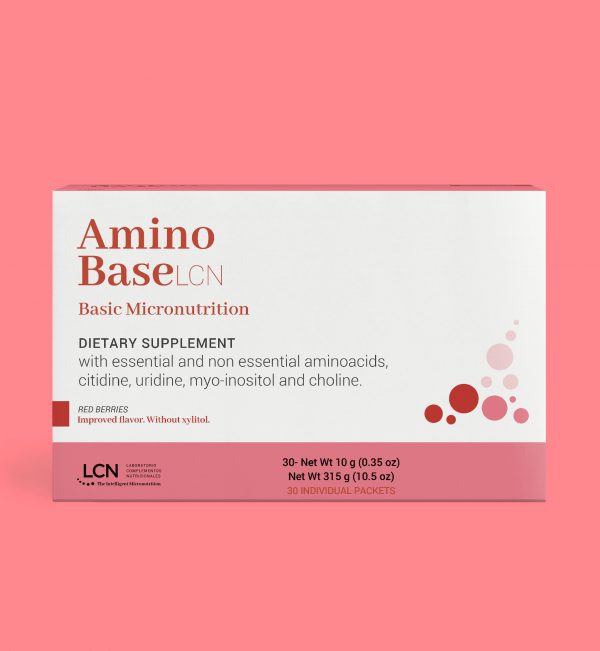
Not all protein amino acids are part of Basic Micronutrition. This supplement only contains amino acids that are necessary at some point in the life cycle without altering physiological processes, in the course of chronic diseases, and which do not interact with drugs. The other amino acids and proteins needed by the body can be formed from these amino acids.
For that reason, there are some amino acids, like glutamine, arginine, glycine, etc., which, despite being protein amino acids, are not part of Basic Micronutrition. The main reasons they are not included are as follows:
Glutamine is the most abundant amino acid in the body. Glutamate is produced by glutamine catabolism. Glutamate can be converted to GABA, but enzymatic difficulties sometimes cause glutamate to accumulate. An excess contributes to a wide variety of disorders and diseases: migraines, convulsions, insomnia, hyperactivity, anxiety, fibromyalgia, neurological and neuromuscular diseases, etc. A high concentration of glutamate can antagonize the action of a variety of drugs, such as anticonvulsants and anti-epileptics, including phenobarbitol, valproic acid, carbamazepine, gabapentin, and others. The importance of glutamine as a nutrient in cancer is related to its capacity to donate biosynthesis precursors (carbon, nitrogen) and a certain amount of energy (substrate-level phosphorylation), both produced through glutaminolysis. Both the physiological processes of scarring and neoplastic transformation of a tissue involve an increase in nucleotide and protein synthesis. Thus, the raw materials necessary for the construction process (biosynthesis) are supplied by amino acids which, in the case of glutamine, can even become conditionally essential. For this reason, in cancer, it would not be appropriate to increase glutamine intake beyond what is ingested in foods and supplied by the muscle reserve.
Arginine is a conditionally essential protein amino acid. It is a substrate for the nitric oxide syntase (NOS) enzyme, which converts argine to nitric oxide. Arginine helps improve the functioning of the coronary endothelium, but it is not one of the amino acids in Basic Micronutrition because it can accelerate growth in some cancers and interacts with a variety of drugs, such as antiplatelets, anti-hypertensives (ACE inhibitors), anticoagulants, nitrates (nitroglycerin), potassium-sparing diuretics, etc. It is also contraindicated in diverse pathologies such as asthma, herpes infections (arginine is essential for replication of the virus), myocardial infarction, and kidney failure.
The body is perfectly capable of synthesizing glycine from threonine. Glycine is an amino acid that is available is almost all foods. We can also obtain glycine from choline Glycine supplementation can worsen symptoms in patients with schizophrenia when they are treated with clozapine. Glycine supplementation in cancer patients is controversial, because some studies indicate that high consumption and increased biosynthesis of glycine exist that promote rapid growth of tumor cells.
Serine is a non-essential amino acid. Serine and glycine are biosynthetically linked and supply essential precursors for the synthesis of proteins, nucleic acids, and lipids that are crucial to cancer cell growth. Moreover, serine/glycine biosynthesis also affects cellular antioxidant capacity, thereby supporting tumor homeostasis. Serine/glycine metabolism is even more important because of genetic and functional evidence indicating that hyperactivity of the serine/glycine biosynthesis pathway leads to oncogenesis. For this reason, it is not included in Basic Micronutrition. High plasma levels of alanine (non-essential amino acid) can compete with threonine (essential amino acid) to cross the blood-brain barrier and reach the central nervous system. According to published studies, high alinine levels would reduce the effectiveness of threonine.
Bibliography
- Altman BJ, Stine ZE, Dang CV. From Krebs to clinic: glutamine metabolism to cancer therapy. Nat Rev Cancer. 2016 Nov;16(11):749.
- Amelio, I., Cutruzzolá, F., Antonov, A., Agostini, M., Melino, G. Serine and glycine metabolism in cancer. Trends in Biochemical Sciences, 2014, 39(4), 191–198.
- Cooperman JM et al.- The role of histidine in the anemia of folate deficiency. Exp Biol Med (Maywood). 2002 Dec;227(11):998-1000.
- DeBerardinis RJ, Mancuso A, Daikhin E, Nissim I, Yudkoff M, Wehrli S, Thomspon CB.
- Beyond aerobic glycolisis: transformed cells can engage in glutamine metabolism that exceeds the requirement for protein and nucleotide synthesis. Proc Natl Acad Sci USA, 2007; 104: 19345-19350
- Dodson S, Baracos VE, Jatoi A, et al. Muscle wasting in cancer cachexia: clinical implications, diagnosis, and emerging treatment strategies. Annu Rev Med 2011; 62: 265–79.
- Kanai M, et al. Tryptophan 2,3-dioxygenase is a key modulator of physiological neurogenesis and anxiety-related behavior in mice. Mol Brain. 2009; 2:8.
- FAO/WHO/ONU Expert Consultation, Technical Report Series 724, p65, 1985.
- Francisco Triana-Martínez1, Luís Enrique Gómez-Quiroz, Mina Königsberg Fainstein. El flujo de la información y la proteostasis: consecuencias fisiológicas reb 31(4): 136-144, 2012
- Fürst P. Old amino substrates in clinical nutrition. J. Nutr 1998;128:789.
- Fürst, P. Basics in clinical nutrition: Proteins and amino acids. Clinical Nutrition ESPEN , Volume 4 , Issue 2 , e62 – e65
- Gibney MJ, Macdonald IA and Roche HM. Nutrición y metabolismo. Editorial Acribia, 2006.
- Hess JR, Greenberg NA. The role of nucleotides in the immune and gastrointestinal systems: potential clinical applications. Nutr Clin Pract. 2012 Apr;27(2):281-94.
- Hyde R, et al.- Amino acid transporters: roles in amino acid sensing and signalling in animal cells. Biochem J. 2003; 373:1–18.
- Jain, M., Nilsson, R., Sharma, S., Madhusudhan, N., Kitami, T., Souza, A. L.,Mootha, V. K. Metabolite Profiling Identifies a Key Role for Glycine in Rapid Cancer Cell Proliferation. Science, 2012,, 336(6084), 1040–1044.
- Mataix, J. Nutrition and human nutrition. Ergón, Madrid, 2001.
- Moreiras O et al.-Tablas de composición de alimentos. Ediciones Pirámide (Grupo Anaya, SA). 2015. 17ª edición revisada y ampliada.
- Park SW, Goodpaster BH, Lee JS, et al, Health, Aging, and Body Composition Study. Excessive loss of skeletal muscle mass in older adults with type 2 diabetes. Diabetes Care 2009; 32: 1993–97
- Sarrafi-Zadeh, S. et al.- Nutritional Modulators of Sleep Disorders. The Open Nutraceuticals Journal, 2012, Volume 5 1-14.
- Shaw GM, et al. Choline and risk of neural tube defects in a folate-fortified population. Epidemiology 2009;20(5):714-719
- Tracy L. et al.- Amino acid catabolism: a pivotal regulator of innate and adaptive immunity. Immunol Rev. 2012 September ; 249(1): 135–157.
- Zhang Y, Yang JM. Altered energy metabolism in cancer: a unique opportunity for therapeutic intervention. Cancer Biol Ther. 2013 Feb;14(2):81-9.
- Waters DL, Baumgartner RN. Sarcopenia and obesity. Clin Geriatr Med 2011; 27: 401–21.
- Whitney E, Cataldo C, Rolfes S. Understanding normal and clinical nutrition. protein: amino acids. Belmont, CA: West/Wadsworth; 1998. pp. 179–217. 4.
- Wu G. Amino acids: metabolism, functions, and nutrition. Amino Acids. 2009 May;37(1):1-17.